
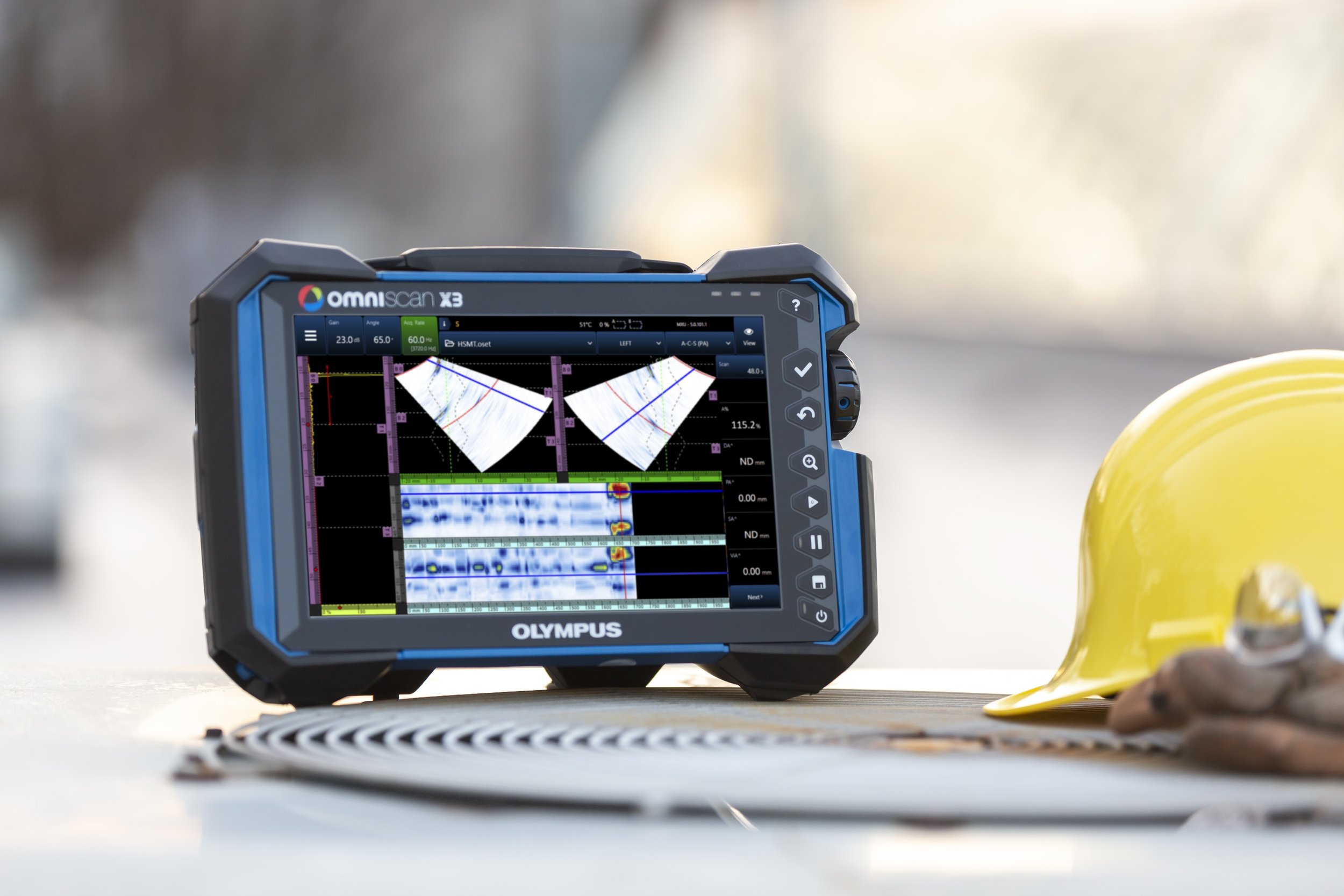
Phased Array UT: See Inside the Weld
Imaged, radiation-free volumetric inspection for code welds and corrosion — without shutting down the site around you.
Phased Array Ultrasonic Testing (PAUT) Services
Phased array ultrasonic testing is an advanced form of UT that steers and focuses sound through a weld electronically, producing a colour-imaged cross-section of the joint instead of a single-point reading. CIC's certified technicians use PAUT for code weld inspection, corrosion surveys and flaw sizing across Alberta — volumetric coverage with no radiation, no exclusion zone, and results your engineer can see, not just read.
What Is Phased Array Ultrasonic Testing?
PAUT uses a probe containing many small elements fired in programmed sequences, sweeping a focused beam through a range of angles in one pass. The instrument assembles the returns into sectorial and encoded scan images that show flaw location, depth and size within the weld volume. In practical terms: one encoded pass replaces multiple conventional UT angles, and the record is a reviewable image.
Where PAUT Outperforms
Code weld inspection on piping and vessels — imaged coverage with accept/reject to ASME Section V methodology
Active construction sites — no radiation exclusion zone means other trades keep working while we scan
Flaw sizing and characterization — depth and height data that visual, MPI or radiography can't provide
Corrosion mapping — encoded thickness imaging over vessel shells, piping and tank plate
Thick sections and complex geometries where radiography struggles or doubles in cost
PAUT vs. Radiography: The Honest Comparison
PAUT wins on safety logistics (no source, no exclusion zone, no night-shift-only windows), on sizing (it measures flaw height; film mostly shows length), and on turnaround during ongoing construction. Radiography wins where the code or client mandates film, on very thin materials, and for some volumetric geometries. CIC fields both methods, so the recommendation follows your joint, code and schedule — and where specs allow either, we'll price both and let you choose.
Certified Technicians, Auditable Data
Phased array is operator-dependent — scan plans, calibration and interpretation make or break the result. CIC PAUT technicians hold CGSB ultrasonic certifications, work from documented scan plans matched to your weld configuration, and deliver encoded data files alongside the report, so a third-party reviewer can audit the raw scans, not just our conclusions. That auditability is exactly what owners' engineers increasingly ask for.
Frequently Asked Questions
Is PAUT accepted in place of radiography?
Frequently, yes — ASME codes provide for ultrasonic examination in place of radiography in many services, subject to the code edition and your engineer's approval. Where your spec allows either method, PAUT usually simplifies site logistics; we'll confirm code acceptance for your exact application before quoting.
What's the difference between PAUT and TOFD?
Both are advanced UT techniques, often run together. PAUT images the weld with steered, focused beams; TOFD uses diffracted signals from flaw tips, giving highly accurate through-wall sizing. On critical welds, a combined PAUT/TOFD scan delivers detection and sizing in one encoded pass.
Can PAUT run while our site keeps working?
Yes — that's a core advantage. No radiation means no exclusion zone: trades keep working adjacent to the scan. Call 780-468-4593 to fit PAUT into an active construction or turnaround schedule.