
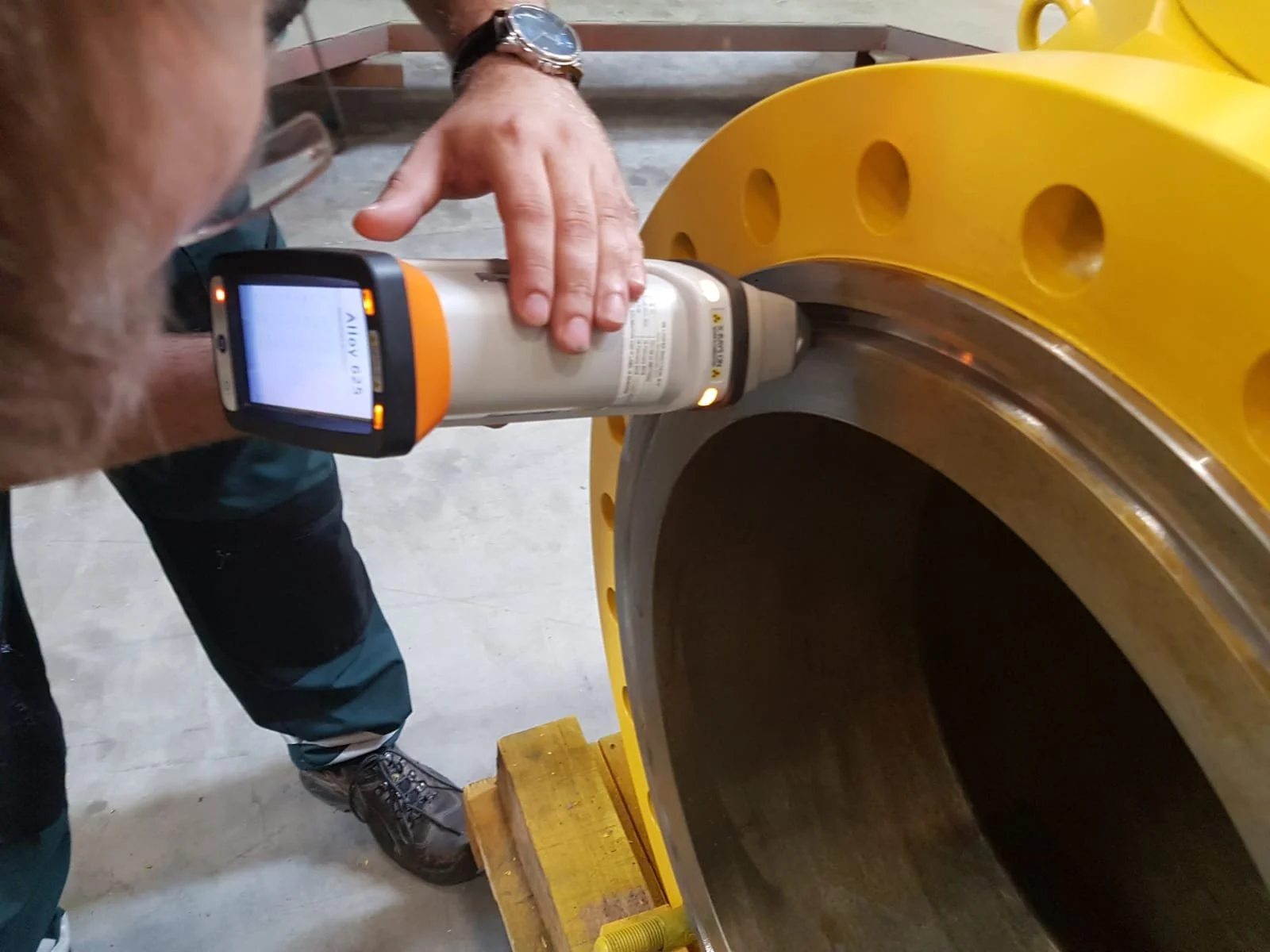
PMI Testing: Verify the Alloy Before It's Welded In
On-site XRF positive material identification with per-point documentation — Edmonton lab
or your laydown yard.
PMI Testing — Positive Material Identification Services
PMI testing (positive material identification) verifies that a component's actual alloy matches its paperwork — before it gets welded into a system where the wrong grade fails in service. CIC performs PMI with handheld XRF analysis on-site and in our Edmonton lab, delivering per-point, traceable results for piping, valves, welds, fittings and fabrications across Alberta.
Why PMI Testing Exists
Material mix-ups are quiet failures: a carbon steel elbow in a low-chrome line, a 304 fitting where 316 was specified, a weld filler that doesn't match the base metal. Everything passes hydro, then sulfidation or corrosion does its work over months. PMI catches the mismatch at receiving, in the laydown yard, or in-line during a turnaround — while it still costs a swap instead of an incident investigation.
How CIC Performs PMI
Handheld X-ray fluorescence (XRF) reads the elemental composition of the material in seconds and matches it to alloy grade — non-destructive, no surface prep beyond cleanliness, usable on installed piping, spools, welds and small components. Every reading is logged against the component's identification, so your records show which flange, which weld, which heat was verified, by whom, and what it read.
Where PMI Fits in Your Program
Receiving verification — check alloy shipments before they enter stores or fabrication
Fabrication QA — verify base metal and filler on alloy welds before and after welding
Turnaround and integrity campaigns — in-line verification of existing circuits flagged by inspection planning
Retroactive PMI — building material records for older units where documentation is thin
Mixed-stock audits — sorting unmarked or co-mingled alloy inventory back into certainty
PMI Alongside the Rest of Materials Verification
PMI answers 'is this the right alloy?' — but integrity questions usually travel in packs. CIC pairs PMI with portable hardness testing (heat-treatment verification, hardness limits in sour service) and ferrite testing (weld ferrite content in stainless and duplex), so one mobilization closes out all three material-verification line items on your inspection test plan.
Frequently Asked Questions
What does PMI testing tell you?
PMI identifies the elemental composition of a metal and matches it to an alloy grade — confirming, for example, that a fitting sold as 316L actually contains the molybdenum that makes it 316L. It verifies material identity; it doesn't measure mechanical properties, which is where hardness testing comes in.
Is PMI destructive? Does it mark the part?
No. XRF-based PMI is completely non-destructive — no cutting, no filings, no arc burn. The analyzer reads through a clean surface contact in seconds, so finished welds, machined faces and in-service piping can all be verified without damage.
How fast can you PMI a shipment or a turnaround scope?
Individual readings take seconds; throughput is driven by access and tagging. Receiving checks often finish same-day, and turnaround campaigns run per your circuit list with per-point logs delivered as we go. Call 780-468-4593 with your point count.