
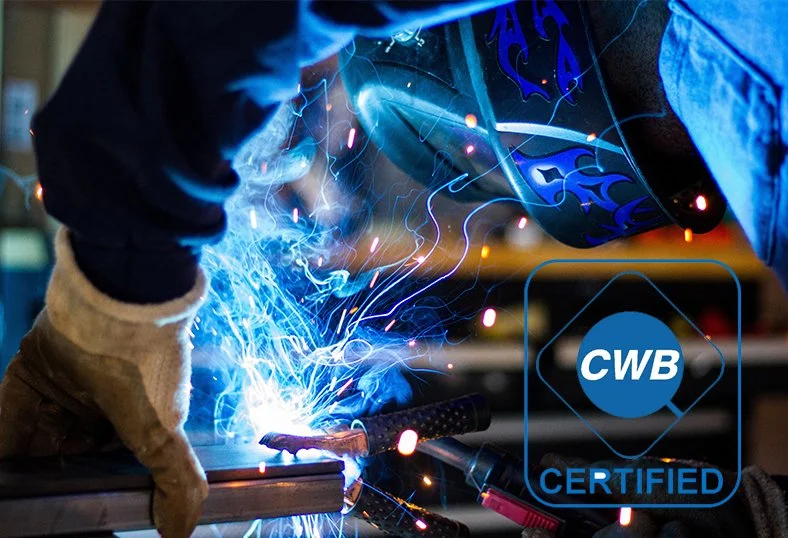
CWB Certified Is a Paperwork Problem
What CSA W59 and W47.1 actually require — and the testing that proves it.
CSA W59 & CWB Compliance: What Alberta Fabricators Actually Need
CSA W59 is the code your welds get judged against. CSA W47.1 is the certification that says your shop is allowed to make them. They are two different documents doing two different jobs, and most of the confusion in Canadian structural welding starts with treating them as one thing. This page separates them, sets out what the CWB actually requires, and shows which pieces CIC can hand you ready to submit.
What Is CSA W59?
CSA W59 — Welded Steel Construction (Metal Arc Welding) — is the Canadian standard governing how steel structures are welded and how those welds are judged. It covers joint design, welding procedure requirements, workmanship, and the acceptance criteria an inspector applies to a finished weld: fillet size and profile, undercut, porosity, cracking, and the limits on each.
The current edition is CSA W59:24, published in 2024, replacing W59:18. If your specification references W59 without naming a year, settle which edition governs before anyone strikes an arc — both acceptance criteria and inspection requirements moved in the 2024 revision.
What Is CSA W47.1 Certification — and Who Needs It?
CSA W47.1 — Certification of Companies for Fusion Welding of Steel — certifies the company, not the weld. Fabricators and erectors performing structural steel welding to W59 in Canada are generally required to hold it, and specifications, building codes and owners routinely make it a condition of bidding.
Certification is issued by the CWB Group, which operates as a certification body accredited by the Standards Council of Canada. No inspection company, consultant or independent lab can issue W47.1 — CIC included. What an independent lab supplies is everything the certification runs on: qualified procedures, qualified welders, and third-party inspection that stands up to audit.
The Three W47.1 Divisions
W47.1 splits certification into three divisions, and the dividing line is engineering supervision:
Division 1 — a full-time registered professional engineer responsible for welding activities
Division 2 — a part-time registered professional engineer responsible for welding activities
Division 3 — no professional engineer required
The division you hold determines the work you are permitted to take. Project specifications frequently name a required division outright, which makes bidding above your division a problem discovered at the worst possible moment. If the required division is ambiguous, the specification and the engineer of record settle it before the quote goes out — not after the steel is on the truck.
What CWB Certification Requires From Your Shop
Four things, broadly:
Qualified welding supervisors — demonstrated experience and written examinations before the CWB accepts them.
A qualified welding engineer — for Divisions 1 and 2, on the full-time or part-time basis that division specifies.
Welding procedures submitted for review and approval — your WPS and WPDS documentation, accepted by the CWB before production welding starts.
Qualified welders and operators — each ticketed for the processes, positions and materials the work actually requires.
A CWB representative audits the shop against all four. Two of them are things CIC produces directly: weld procedure qualification generates the PQR data your procedures are built on, and welder qualification testing produces the tickets. Both run through our own Edmonton lab, so the mechanical testing behind them isn't waiting in a third party's queue while your certification file sits open.
What W59 Requires for Inspection and NDT
W59 does not leave inspection to preference. Visual inspection is the baseline on every weld, with acceptance limits written into the standard. Beyond visual, the method required depends on the weld's category and the structure's service — cyclically loaded and tension-critical work carries volumetric requirements that statically loaded work does not.
In practice that means radiographic or ultrasonic examination on complete-joint-penetration welds where the code or the engineer of record calls for it, magnetic particle testing for surface and near-surface indications in ferromagnetic steel, and liquid penetrant where MPI cannot be used. CIC runs every one of them in-house. That matters more than it sounds: when visual inspection turns up something questionable, the confirming method happens in the same visit rather than next week's.
What Changed in CSA W59:24
The 2024 edition brought seven substantive updates. The one worth flagging to anyone running an inspection program is encoded phased array — W59:24 added requirements for encoded phased array ultrasonic inspection, formalising a technology the industry had already moved to.
The other six: new guidance on when additional toughness testing is needed for base metals with specified toughness properties; limits on intentional boron additions; expanded design and welding guidance for skewed joints; new requirements addressing the increased use of hollow structural sections; recognition of common cast steel grades and casting-specific welding; and requirements for twin-wire parallel electrode configurations in SAW, FCAW, MCAW and GMAW.
If your inspection scope was written against W59:18, the phased array clause is the one most likely to change what you need on site. CIC runs encoded phased array ultrasonic testing — worth a conversation before your next scope is written rather than after it's been rejected.
Understanding CSA W178.2 Inspector Levels
Welding inspectors in Canada are certified under CSA W178.2, in three levels:
Level 1 — may conduct inspections, but works under the supervision of a certified Level 2 or Level 3
Level 2 — fully competent to inspect without supervision
Level 3 — additional technical knowledge; capable of further tasks such as reviewing inspection and test plans
Progression is time-gated: two years as a certified Level 1 before Level 2, four years at Level 2 before Level 3, with written and practical examinations at each step. When a specification names an inspector level, it is naming a specific competence rather than expressing a preference — send the spec and we will match the certification to it.
Where CIC Fits — and Where the CWB Does
A clean division of labour, worth stating plainly because vendors blur it.
The CWB certifies.
They audit your shop, accept your supervisors and welding engineer, approve your procedures, and issue W47.1. That is their role and nobody else's.
CIC supplies what you bring to that audit — and what your projects need afterward.
Weld procedure qualification — test plates through bends, tensiles and macros, with the PQR that supports your WPS under CWB requirements or ASME Section IX.
Welder qualification testing — coupon welding, specimen preparation, mechanical testing and the documentation that turns a passed test into a usable ticket.
Welding inspection — third-party inspection by CWB certified inspectors to W59 acceptance criteria, with the NDT the code requires run by the same company on the same visit.
Because CIC does not fabricate, weld or repair, there is no conflict of interest sitting behind the signature on your report. That is the entire point of third-party inspection, and it is precisely what your CWB auditor and your engineer of record are looking for.
Qualifying procedures, ticketing welders, or booking inspection for a W59 job? Call 780-468-4593 or send the scope through our quote form — tell us the division you hold and the specification you are working to, and we will match the testing to it.
Frequently Asked Questions
What is the difference between CSA W59 and CSA W47.1?
W59 is the welding code — it governs joint design, welding procedures and the acceptance criteria a finished weld is judged against. W47.1 certifies the company doing the welding, requiring qualified supervisors, an approved welding engineer, accepted procedures and ticketed welders. W59 judges the weld; W47.1 qualifies the shop allowed to make it.
Who issues CWB certification?
The CWB Group issues CSA W47.1 certification, operating as a certification body accredited by the Standards Council of Canada. Inspection companies, laboratories and consultants cannot issue it. What they supply is the qualified procedures, welder tickets and independent inspection that certification and ongoing compliance depend on.
What is the current edition of CSA W59?
CSA W59:24, published in 2024, replacing W59:18. It introduced seven substantive updates, including requirements for encoded phased array ultrasonic inspection, new toughness testing guidance, hollow structural section requirements and cast steel provisions. Confirm which edition your project specification references before welding begins.
Which W47.1 division does my shop need?
Division 1 requires a full-time professional engineer responsible for welding, Division 2 a part-time engineer, and Division 3 none at all. The division you need is driven by the work you intend to bid, and project specifications often name it directly. Confirm it with the engineer of record before quoting.